Galaxsys - Crash Game
Tower Rush slot guide: features, 96.07% RTP and top casinos
The same tower can be built for practice credits or for real money, and its rules stay put either way. Here the free and paid modes sit next to each other, followed by a walk through each round, manual and preset exits, three special floors, the RTP band Galaxsys publishes and the habits that help keep every session relaxed and within budget.
Play responsibly. The demo features virtual credits — no real cash involved. 18+ only. Ensure gambling is legal in your area.
Playing methods
Playing the game
How the multiplier works
Begin by placing your bet, mindful of the stakes you wish to risk during the game.
How to cash out
Watch closely as the multiplier increases with each moment the tower stands.
How to Engage with Tower Rush
Choose to cash out before the tower collapses, securing your winnings.
In Summary: Tower Rush is an exciting crash game developed by Galaxsys, boasting an RTP of 96.3–97.55% and medium to high volatility. With stakes ranging from 0.10 to 100, players can win up to 100 times their bet. Test your skills with the demo version.
Gameplay Features
Unique Gameplay Features
Cashing Out
This feature allows players to withdraw their winnings at any point, making timing crucial.
Auto Cashing Out
Use this setting to automatically cash out at a predetermined multiplier, reducing stress.
Guaranteed cashing out
This ensures the fairness and transparency of each round, letting players verify outcomes.
Game Specs
Game details
Picture one tower raised twice. On the first attempt, Tower Rush runs on virtual credits and nothing real changes hands; on the second, the same structure climbs with money behind every floor.
Nothing in the rules shifts between those two sittings. A round always begins on vacant ground, each added level nudges the multiplier upward, and each added level leaves the next placement a little shakier. What changes is how much the decision weighs. With demo credits, a collapse is a lesson. With a real stake, it is a cost.
That contrast is the thread of this page. Tower Rush is laid out here in its two modes, side by side, and then taken apart piece by piece: how one round flows, how you collect, what Frozen Floor and its two companions change, which figures Galaxsys publishes, and which habits keep a session sane.
Nothing below hints at a shortcut. The game is random, no round leans on another, and the most useful thing a player can bring is a clear idea of what each mode is for. Settle that first. Whether money belongs in the picture at all is a question better answered afterwards.
Demo and real play in Tower Rush compared
Free and paid Tower Rush share one engine, one rulebook and one screen. The differences sit around the edges: what fuels each round, who may sit down, and which limits frame the session.
| Point | Demo | Real stakes |
|---|---|---|
| Credits | Virtual balance handed out free, worth nothing in cash | Funds you deposit; per-round stake set by the casino, bounded by 0.10 CAD and 100 CAD |
| Access | Available on many casino sites, frequently right from the lobby | Only through licensed operators that list Galaxsys games |
| Age | Registration and entry conditions depend on the casino | Adults only: 18+ |
| Limits | No financial ceiling, because nothing real is wagered | Operator tools for capping deposits and playing time, plus your own budget |
| Outcome of a collapse | That round's virtual credits vanish | That round's money is gone |
| Cashing out | Adds more play credits | Returns real money, worked out as stake times the displayed figure |
Scan any row and a pattern appears: gameplay identical, consequences not. A tower toppling in demo mode costs a few seconds. A tower toppling with real money riding on it takes the whole stake with it, and no later floor gives it back.
This is why the free version deserves more respect than a "lite" label. It is the complete game, with the same random outcomes and the same special floors able to show up, just without the money. Plenty of people treat it as a sandbox and stay there, which is a perfectly reasonable way to enjoy a crash-style title.
Others use it as a rehearsal. Either route is fine, provided you have picked one before any level is placed.
One last practical detail sits outside the table. Not every casino listing the game offers the free mode, and paid sessions are limited to operators holding a licence. Where you open the game decides which column applies to you.
What the demo is good for
The free mode exists so you can learn how a round breathes without paying tuition. A few minutes reveal how quickly levels stack, how the multiplier answers each one, and how abrupt a fall feels when it finally comes.
It is also the cheapest testing ground for the automatic exit. Enter a target, let several rounds play out, and note how frequently the structure survives long enough to hit it. Those notes forecast nothing about the next attempt, yet they give you a sense of tempo before your own cash is involved.
Simply watching Tower Rush has value too. Letting rounds unfold with modest virtual amounts shows the flow, the timing of each choice, and the moment when the itch for one extra level starts to bite.
Keep one caveat in mind. Play money changes behaviour. People hang on longer with nothing to lose, so a demo stretch can make big multipliers look more ordinary than they feel once a balance is involved. Read demo results as a portrait of the mechanics, never as a preview of a paid session.
Moving to real stakes in Tower Rush
Crossing over is a money decision first and a gaming one second. The structure on screen behaves exactly as it did for free; the balance beneath it simply belongs to you now.
The route usually has four stages. Open an account with a licensed casino carrying Galaxsys titles, pass whatever identity verification that operator asks for and add funds. Tower Rush is then usually listed under instant games or crash games. Nobody under 18 may play for money.
An illustration makes the payout arithmetic concrete. Say you put 25 CAD on a round and collect while the counter reads x1.40. You receive 35 CAD, which is the stake times whatever multiplier was showing when you pressed. The x1.40 figure is purely illustrative, chosen only to demonstrate the maths; no floor is tied to that number.
Had the structure fallen before you collected, those 25 CAD would have vanished. Weigh both endings before confirming a stake.
Promotional funds need their own reading. A casino may set conditions such as the share a title contributes towards wagering, outright exclusions, or a bet ceiling during an active offer. Terms differ from one operator to the next, so read them before spending bonus money here.
Tower Rush stake limits and versions
A Tower Rush round accepts a bet as modest as 0.10 CAD; the ceiling sits at 100 CAD. Exactly where a particular lobby sits inside that band comes down to the casino's settings, so your own floor and ceiling may be tighter than the full span.
Size each stake to your budget, not to the multiplier you dream of. Modest amounts spread a session across many rounds; heavy ones shorten it fast, especially because every fall takes the entire amount placed on that round.
Return to player varies as well. Galaxsys quotes RTP figures bounded by 96.3% below and 97.55% above, and the applicable percentage hinges on which build each operator installs. Two lobbies with the same title may therefore be running different configurations.
Finding the precise number is easy. You will see it listed among the rules for whichever build loads, normally reachable straight from the game window. A quick look tells you exactly which setup you are facing.
Remember what that percentage really measures. It is a statistical average computed over an enormous sample of rounds. A single evening can land far from it on either side, and RTP says nothing about how your next session will go.
The Galaxsys tower game in brief
Galaxsys developed Tower Rush as a crash-style instant game and released it in 2026. One sentence covers the concept: you stack a tower one floor at a time, and you choose when to walk away before it gives.
Being an instant title, it skips reels and paylines and has no long pauses between results. Rounds are brief, decision points are obvious, and outcomes land quickly. That pace is a big part of the draw, and a good reason to glance at the clock now and then.
The central tension is simple to feel. Each new level pushes your potential return higher. It also makes it more probable that whatever comes next sends everything crashing. Collecting freezes the current figure in your favour; waiting reaches for more at mounting risk.
It helps to separate studio and casino. The game was developed by Galaxsys. The casino is the host: it holds the licence, runs your account and payments, and picks which version and stake settings to switch on. Deposits, withdrawals and identity checks are questions for the casino; the game logic comes from the developer.
Three special floors add variety to Tower Rush, and a dedicated section further down explains them.
Round mechanics in Tower Rush
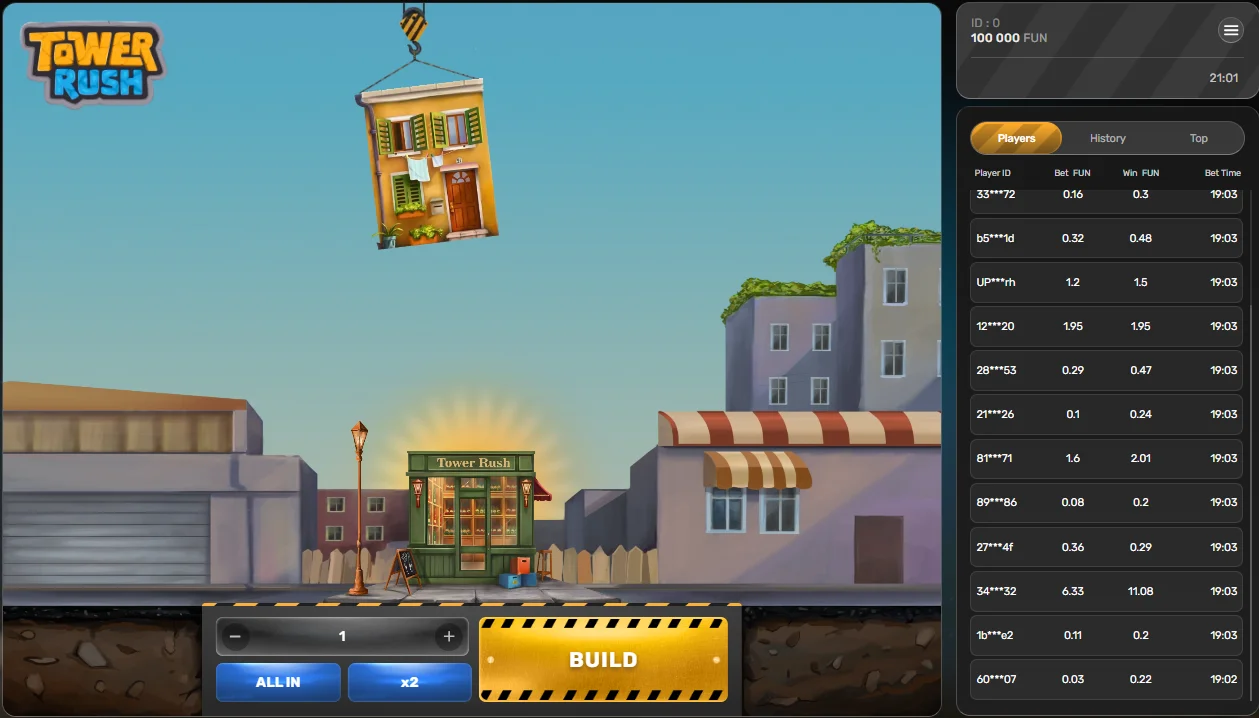
Every round follows the same sequence, whether the balance is virtual or real. From first choice to final outcome, it runs like this.
Pick a stake. Choose an amount the casino permits, bearing in mind the game never goes under 0.10 CAD or above 100 CAD, matched to the budget fixed before you started. Optionally preset an exit. Enter a goal multiplier beforehand and the game will collect for you once that level arrives. Leave it blank if you would rather decide live. Launch the round. Your tower starts from a vacant plot, without a single level in place. Follow the climb. Each level that lands lifts the multiplier, while making the following placement riskier. Stay alert to special floors. A special floor can pop up during the climb and alter its course. Collect or carry on. Any time before a fall, you may bank whatever the current multiplier makes of your stake. Continuing means chasing a higher figure while accepting extra danger. Let the round settle. Either you collected and the payout lands in your balance, or the tower fell first and that round's stake is lost.
Then a fresh round begins from nothing. Nothing from the earlier tower survives: its height, the moment it fell and the figure you took are irrelevant to the round ahead. Each Tower Rush round is self-contained, with a random result.
That point bears repeating precisely because the sequence feels so legible. Three quick falls in a row do not mean a tall one is owed to you, and a streak of generous exits does not signal that a fall is near. The plot is empty again and the odds are untouched.
Cash-out tools in Tower Rush
Two methods let you close a round on your own terms. Both return the same amount, namely your bet times the on-screen figure when you press, and both only work if they act before the tower gives way.
Manual cash-out
Here the timing is entirely yours. You follow the climb and collect whenever the figure on screen feels right, at whatever instant you choose ahead of a fall.
The strength is flexibility: you respond to each round as it develops, including the arrival of a special floor. The weakness is human. Quick rounds encourage hasty calls, and the pull towards one extra level is exactly what a collapse punishes. Settle on a rough exit point before launching, and the manual option becomes a tool instead of a temptation.
Automatic cash-out
The automatic option takes timing out of your hands mid-round. Before launching, you choose a goal multiplier; if the climb reaches it, the game banks the payout without any input from you. If the tower collapses first, the round is lost as usual.
This suits anyone wanting consistency across a session, or anyone who knows they tend to linger. A modest target is reached more often than an ambitious one, though no setting alters the randomness of a given round. Trying different targets in Tower Rush demo mode first costs nothing.
Frozen Floor, Temple Floor and Triple Build in play
Three special floors may surface during a round and reshape it. Their precise behaviour, and any values tied to them, are explained by the rules of the particular version you load. In broad terms:
Frozen Floor: it secures the winnings reached at that point. Once it lands, everything accumulated up to that level is protected, which changes the sums for anyone deciding whether to keep stacking. Temple Floor: another special floor, and it handles the multiplier in its own particular way. Once Temple Floor appears, the multiplier stops following the standard level-by-level climb, so read how your version explains it. Triple Build, the third special floor, likewise moves the multiplier in a distinct manner. Its effect on the multiplier's progress is defined in the game's rules rather than following the usual path. Their arrival is part of the randomness. No one can forecast or summon any of the three, and a round can just as well end without any of them showing up. Free and paid rounds both include them. These floors belong to Tower Rush itself, which makes demo play a natural way to watch them work before money is involved. Rules outrank assumptions. Since operators can install different versions, consult the help or rules screen for how these floors behave in the copy open on your screen, not in one you saw somewhere else.
A practical note on Frozen Floor: protecting winnings at one level does not make the remainder of the round free of risk in a wider sense. Your version's rules spell out exactly what is still exposed once building resumes above it.
Rules that state volatility and top wins
Certain figures have no single published value valid for every lobby. Volatility, the highest reachable multiplier and the top prize are each documented in the rules belonging to every version, and those details may vary between installations.
That makes the rules screen the only trustworthy reference. Ahead of any paid session, open it and look for three things: the RTP of that build, how volatile it is, and any limit on multipliers or payouts. Where a figure is absent from that screen, assume nothing.
The check takes under a minute and guards against a common error: carrying expectations from one operator's version into another's. A ceiling noticed at one casino may simply not apply at the next.
The same screen also covers the special floors for that version, so numbers and features sit together in one place.
Devices for both Tower Rush modes
Tower Rush opens in an ordinary web browser, so a phone or tablet works as well as a desktop computer. There is nothing to install, for free play or for paid play.
On a phone, the practical concerns are a steady connection and a layout that suits quick choices. Losing signal mid-round is annoying, so pick a spot with dependable coverage. On a compact display, locate the collect control before placing any stake.
Since the game requires no download, treat any app or APK claiming to be a special edition with suspicion. Launch it through a licensed casino's website instead.
Responsible play with Tower Rush
Short rounds give the game much of its charm, and they also let a session stretch past what you intended. A round can open and close within seconds, so a session can drift well beyond its planned end without one moment standing out.
Fix two limits before starting: an amount you could lose comfortably and a session length. Jot them down if that helps. Once either is reached, stop, however the last round turned out.
Lean on the tools operators supply. Licensed casinos provide deposit caps and time limits for exactly this reason, and self-exclusion exists for when a longer pause is needed. Brief breaks during play help as well, simply by interrupting the momentum of rapid rounds.
Do not chase losses. Lifting your stake to recover a fallen tower usually digs the hole deeper, because the next round carries no memory of the last one.
Distrust anything that offers an edge. Predictors, bots, signal groups and unofficial websites claiming to foresee collapses cannot deliver, since outcomes are random. Unlicensed casinos call for the same caution.
Should gambling no longer feel like fun, or start causing worry, it is time to speak with people trained to help, at a professional help service. Asking for support early is a sound move, never a failure.
Things that stay true in both modes
Virtual credits or real money, a handful of facts hold firm every time Tower Rush loads. Keep them in view.
The installed version determines the RTP. Galaxsys sets the band between 96.3% and 97.55%; your version's rules hold the exact figure. A fall wipes out that round's stake. Fail to collect before the tower gives way and the money placed on that round disappears in full, with nothing partially returned. The rules are where top win and volatility need confirming. Each version states them; no universal figure applies. Nothing on offer can promise a win. Each round is random and stands alone, and no pattern, system or tool reveals when a tower is about to drop. Paid play needs a licensed casino and an age of at least 18. Use only operators that hold a licence and carry Galaxsys games.
| Launch date | June 2026 |
| RTP | 96.3–97.55% |
| Wagering limits | 0.1 – 100 |
| Risk level | High |
| Game Studio | Galaxsys |
| Category | Crash-style game |
| Potential earnings | 100× |
Game Comparisons
| Play | Game Studio | RTP | Potential earnings | Risk level |
|---|---|---|---|---|
| Tower Rush | Galaxsys | 96.3–97.55% | 100× | High |
| Limbo | Spribe | 99% | 1,000,000× | Elevated |
| Mines | Spribe | 97% | Unrestricted | Flexible |
| Rocketon | Galaxsys | 96.5% | 5,000× | Elevated |
Help
Common Questions
Do I need to register to try the demo?
Many casino sites offer demo play. Whether an account is required beforehand varies, because each casino sets its own registration rules.
Is the age limit the same for the demo?
Real-money play is 18+.
Do special floors appear in demo rounds?
Yes. The special floors belong to the game rather than to the payment mode, so free rounds can feature them exactly as paid ones do. Spotting them in demo play is a handy way to grasp their effect before real funds enter the picture.
Can demo winnings be withdrawn?
No. Demo balances hold zero monetary worth and cannot be converted, transferred or paid out. A towering demo result is practice, and the balance resets with no monetary consequence.
Is the stake range the same everywhere?
Not necessarily. Tower Rush itself works within a 0.10 CAD minimum and a 100 CAD maximum per round, yet every casino chooses its own settings within that window. Check the limits displayed in the version you load, next to its rules.
Which casinos offer Tower Rush?
Licensed casinos that carry Galaxsys games.
Ready to take on the tower in Tower Rush?
For ages eighteen and above. Play wisely. Be aware that betting can lead to losses — only stake what you can afford.